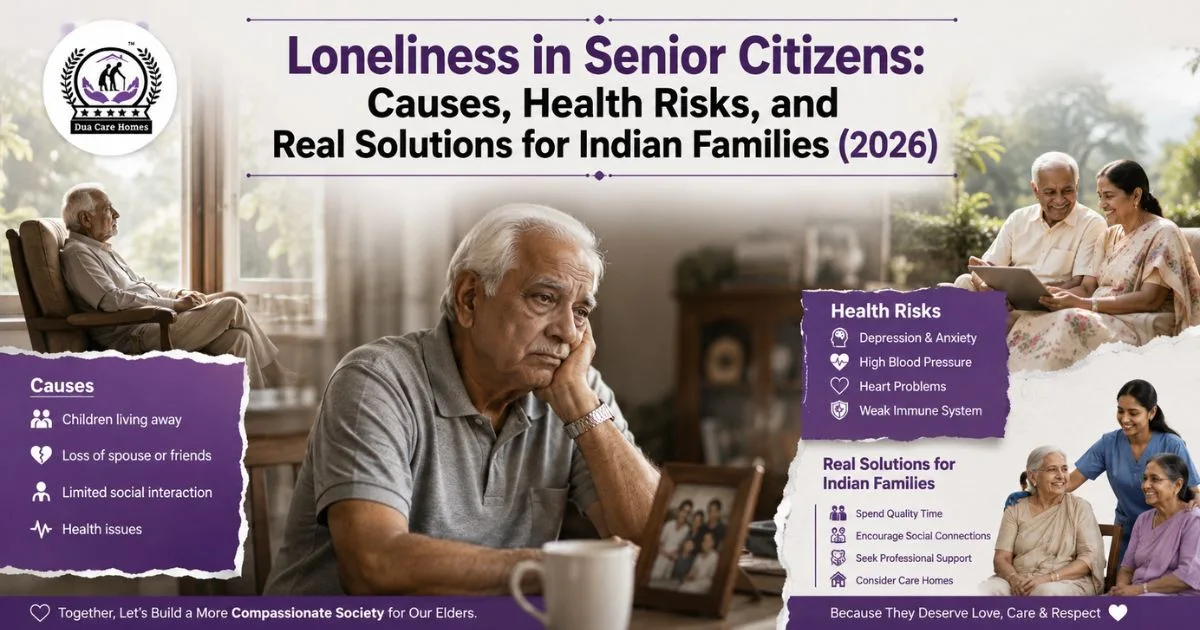
Nearly half of India’s older adults report feeling lonely on a regular basis. If you’re watching a parent or grandparent withdraw, skip meals, or stop calling back — you’re not imagining it, and you’re not alone either.
Loneliness in senior citizens is the persistent, subjective feeling of social disconnection that older adults experience when their actual relationships fall short of what they need. It’s different from simply living alone. A senior can live with family and still feel profoundly lonely, or live alone and feel well-connected. The difference lies in the quality and frequency of meaningful contact, not just its presence.
This guide by Dua Old Age Caring Institution covers why loneliness develops in older adults, what it does to their health, how to spot it early, and which interventions actually work — backed by Indian and global research.
What Causes Loneliness in Senior Citizens?
Loneliness in senior citizens rarely stems from one event. Instead, it builds gradually as life circumstances strip away regular social contact.
Retirement removes daily workplace interaction almost overnight. Many seniors lose not just income structure but an entire social circle built around colleagues. Bereavement compounds this loss. Losing a spouse, sibling, or close friend removes a primary source of companionship, and grief itself often pushes people further into isolation.
Family migration plays an outsized role in India specifically. Adult children moving to other cities or abroad for work leaves many elderly parents managing daily life alone. Consequently, this pattern shows up strongly even in high-development states — Kerala, despite strong healthcare infrastructure, faces significant elderly isolation linked to migration and family fragmentation, since the state’s elderly population runs around 16.5% of its total, one of India’s highest proportions.
Mobility loss and chronic illness also restrict a senior’s ability to leave the house, attend social events, or maintain friendships that once required physical presence. Meanwhile, hearing or vision decline makes conversation and group settings exhausting, so many seniors quietly opt out rather than struggle through.
You May Visit for This – Dua Old Age Caring Institution Elder Care Services
How Common Is Loneliness in Senior Citizens in India?
Loneliness affects a substantial share of India’s older population, and the numbers vary sharply between urban and rural settings. Research places the overall prevalence among Indian elderly at roughly 48%, based on a 2020 study. A more recent 2024 study found the figure climbs to 66.4% in rural areas specifically, where family migration and limited healthcare access compound the problem.
Social isolation, a related but distinct condition, affects almost 34% of India’s elderly population according to recent reporting. Globally, the picture is similarly serious: 20–40% of elderly populations worldwide report moderate to severe loneliness, a figure rising in both high-income and low-to-middle-income countries.
| Population Group | Loneliness Prevalence | Source |
| Indian elderly, overall (2020 study) | ~48% | Mind Voyage / Loneliness Statistics in India |
| Indian elderly, rural areas (2024 study) | 66.4% | Mind Voyage / Loneliness Statistics in India |
| Indian elderly, social isolation | ~34% | The CSR Journal, June 2025 |
| Global elderly, moderate–severe loneliness | 20–40% | IntechOpen, 2025 |
| Elderly in old-age homes, moderate–severe loneliness | ~70% | BMC Geriatrics, 2023 |
Table 1: Loneliness and social isolation prevalence among elderly populations in India and globally.
India’s elderly population currently stands above 138 million, and it’s projected to double by 2050. As a result, even a modest percentage increase in loneliness prevalence translates into millions of additional affected individuals over the next two decades.
What Health Risks Does Loneliness in Senior Citizens Create?
Loneliness in senior citizens isn’t just an emotional burden — it’s a measurable physical health risk. Researchers now rank chronic loneliness alongside major risk factors like smoking and obesity.
Isolated seniors face a 29% increased risk of death from heart disease and a 32% increased risk of stroke-related death, according to an American Heart Association scientific review. Socially isolated adults with three or fewer monthly social contacts may carry a 40% increased risk of recurrent stroke or heart attack. Notably, people with existing heart disease who were socially isolated showed a two- to three-fold increase in death risk over a six-year follow-up period.
Cognitive decline follows a similar pattern. Persistent loneliness in later life independently raises dementia risk, while recovering from loneliness appears to build resilience against it. Loneliness has also been linked to elevated blood pressure and heightened inflammatory responses to stress.
| Health Outcome | Increased Risk | Source |
| Death from heart disease | 29% | American Heart Association |
| Death from stroke | 32% | American Heart Association |
| Recurrent stroke/heart attack (low social contact) | 40% | American Heart Association |
Table 2: Documented health risks associated with loneliness and social isolation in older adults.
Beyond physical illness, loneliness heightens the risk of depression and anxiety, and it frequently worsens existing cognitive impairment. For families, recognizing these risks early is the first step toward intervention.
What Are the Warning Signs of Loneliness in an Elderly Parent?
Loneliness often hides behind everyday excuses, so families need to watch for behavioral shifts rather than direct complaints.
Withdrawal from previously enjoyed activities is usually the first sign. A parent who once attended temple visits, kitty parties, or morning walks regularly may start declining invitations. Similarly, reduced phone contact — shorter calls, delayed responses, or reluctance to video chat — often signals emotional distancing, not just busyness.
Sleep and appetite changes frequently accompany loneliness. Seniors may sleep excessively as a way to fill empty hours, or lose interest in cooking and eating properly. In addition, increased complaints of physical symptoms — vague aches, fatigue, or minor illnesses — sometimes mask emotional distress that the person can’t otherwise articulate.
Finally, watch for neglect of personal hygiene or home upkeep. This shift usually indicates the loneliness has progressed toward depression and needs prompt attention, ideally from a geriatric mental health professional.
What Are Effective Elderly Loneliness Solutions?
Elderly loneliness solutions work best when they combine social connection with structured routine, rather than relying on occasional visits alone.
Home-based interventions suit seniors who prefer to stay in familiar surroundings. These include scheduled companion visits, video calls with distant family, community volunteer programs, and pet companionship. However, home-based care often depends heavily on family coordination and can fall apart if a primary caregiver becomes unavailable.
Facility-based care, such as structured old-age homes and senior day-care centers, offers built-in peer interaction and daily programming. Group meals, shared activities, and on-site staff create consistent social contact that’s harder to maintain at home. That said, research shows elderly residents of old-age homes report higher loneliness rates than those living with family — around 70% report moderate or severe loneliness in this setting, which underscores that quality of interaction matters more than simply being around other people.
| Approach | Best Suited For | Key Advantage | Key Limitation |
| Home-based companion care | Seniors preferring familiar surroundings | Personalized, flexible schedule | Depends on caregiver availability |
| Senior day-care centers | Seniors with family present but working during the day | Daily structured socialization | Limited evening/weekend coverage |
| Residential old-age homes | Seniors needing full-time supervision | Round-the-clock peer contact and care staff | Risk of institutional loneliness if engagement is passive |
| Community/volunteer programs | Mobile, socially active seniors | Low cost, intergenerational contact | Inconsistent frequency |
Table 3: Comparison of common elderly loneliness solutions by setting and trade-offs.
Above all, the most effective approach tends to combine settings — for instance, day-care socialization paired with evening family contact — rather than relying on a single fix. Digital literacy training, which helps seniors use video calls independently, has also shown promise as a low-cost addition to any care plan.
How Does Social Isolation in Elderly Adults Differ Between Urban and Rural India?
Causes of social isolation in elderly adults shift significantly depending on geography, and solutions need to reflect that difference.
Rural elderly face isolation primarily from family migration, as younger generations move to cities for work. Limited healthcare access and fewer organized senior programs deepen the problem, contributing to the 66.4% rural loneliness prevalence noted earlier. Urban elderly, on the other hand, generally have greater access to healthcare facilities and senior citizen centers, yet they often lack meaningful community bonds or consistent time investment from family members.
| Factor | Rural Elderly | Urban Elderly |
| Primary cause of isolation | Family migration, limited services | Weak community bonds despite access |
| Healthcare access | Limited | Comparatively strong |
| Reported loneliness prevalence | 66.4% | [VERIFY — urban-specific elderly figure not separately confirmed in current sources] |
| Recommended focus | Mobility services, home-based care, community outreach | Digital literacy, neighborhood clubs, intergenerational programs |
Table 4: Urban vs. rural differences in elderly social isolation in India.
Understanding this split matters for families and care providers alike. A solution designed for urban seniors — say, a digital literacy class — won’t help a rural parent without reliable internet access. Instead, rural interventions need to prioritize physical outreach and mobility support first.
Get Support for an Aging Parent Facing Loneliness
If you’ve recognized these warning signs in a parent or loved one, waiting rarely helps — loneliness tends to deepen without structured intervention. Dua Old Age Caring Institution offers companion care, day-care programs, and residential support across Delhi NCR, built specifically around consistent social engagement rather than passive supervision.
Contact Us For More Information about this.
Conclusion
Loneliness in senior citizens is common, measurable, and dangerous to ignore — nearly half of India’s elderly report feeling it regularly, and the health consequences rival smoking in severity. Fortunately, the warning signs are recognizable, and effective elderly loneliness solutions exist for nearly every situation, from home-based companionship to structured day-care. The first step is simply paying attention.
Frequently Asked Questions
What is the main cause of loneliness in senior citizens?
Family migration, bereavement, retirement, and mobility loss are the leading causes, often combining gradually rather than striking all at once.
How common is loneliness among elderly people in India?
Roughly 48% of Indian elderly report loneliness overall, rising to 66.4% in rural areas based on recent research.
Can loneliness actually affect physical health?
Yes — loneliness raises the risk of heart disease death by 29% and stroke death by 32%, according to the American Heart Association.
What are the warning signs of loneliness in an elderly parent?
Withdrawal from activities, reduced phone contact, appetite or sleep changes, and neglect of personal hygiene are common early indicators.
Do old-age homes reduce loneliness in seniors?
Not automatically — around 70% of residents in old-age homes still report moderate to severe loneliness, so the quality of daily interaction matters more than the setting itself.