

When there’s no one to care for parents, the situation can feel overwhelming — full of guilt, distance, and financial worry all at once. Adult children today are stretched across careers, kids, and often different cities, so it is increasingly common to have no one to care for parents on a daily, hands-on basis. The good news: not having a live-in family caregiver does not mean your parent has to go without support. This guide covers the warning signs, every professional and community care option available in 2026, real costs, funding sources, and a step-by-step plan you can start today.
Why So Many Families Have No One to Care for Parents Right Now
This isn’t a personal failure — it’s a demographic shift. Smaller families, later childbearing, higher divorce rates, and adult children living farther from home have all combined to shrink the pool of available family caregivers, even as the number of older adults needing help keeps growing.
Researchers who modeled U.S. kinship patterns through 2040 found that population aging alone will push the number of older adults with care needs but no family caregiver to roughly 7.7 million, with unmet care needs reaching about 14 million people — a 22.9% jump from 2022 levels (PubMed / Population and Development Review).
Key Statistics on Aging Without a Family Caregiver
| Statistic | Figure | Source |
|---|---|---|
| Americans aged 65+ who live alone | ~28% (about 10.7–13.8 million people) | U.S. Census Bureau |
| Adults over 55 living without close family support (“solo agers”) | 22+ million | U.S. News & World Report |
| Older adults projected to have no family caregiver by 2040 | 7.7 million | Population & Development Review, 2026 |
| Unpaid family caregivers currently active in the U.S. | ~53 million | SeniorLiving.org / Pew Research |
| Seniors living alone with a disability, vision/hearing loss, or cognitive issue | Nearly 4 in 10 | KFF Health News analysis of Census data |
| U.S. adults 65+ (2023) | 58 million (17.3% of population) | U.S. Census Bureau |
The takeaway: if you feel like there’s no one to care for your parents, you are part of a large and growing group, not an outlier. Understanding that helps remove some of the guilt — and makes it easier to move straight into planning.
Many people in this position are also part of the so-called “sandwich generation” — simultaneously raising children while trying to support aging parents. Even adults with siblings often end up as solo caregivers, since one sibling frequently lives closest or is the only one able or willing to step in, according to caregiver-support organizations like AgingCare. Recognizing this pattern early makes it easier to ask for outside help before burnout sets in.
Signs Your Aging Parent Needs Care Now
Before choosing a solution, confirm what kind of help is actually needed. Watch for these red flags during visits, calls, or from reports by neighbors:
- Physical signs: unexplained bruises, weight loss, poor hygiene, or a decline in mobility
- Household signs: spoiled food, unpaid bills piling up, or a noticeably messier home
- Medical signs: missed medications, duplicate prescriptions, or skipped doctor appointments
- Cognitive signs: repeating questions, getting lost on familiar routes, or confusion about dates
- Safety signs: falls, near-misses while driving, or leaving the stove on
- Emotional signs: withdrawal from friends, loss of interest in hobbies, or signs of depression
If you notice two or more of these, it’s time to move from “keeping an eye on things” to actively building a care plan.
What to Do When No One Is Available to Care for Parents (Step-by-Step)
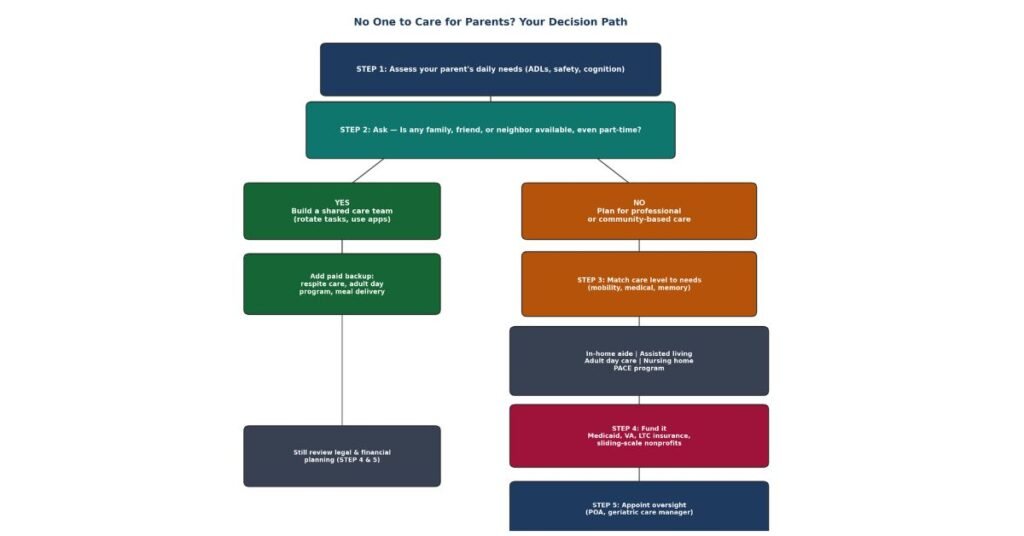
The image below maps the decision path most families follow — from assessing needs through funding and oversight.
Show Image
Step 1: Assess Daily Needs Honestly
List out Activities of Daily Living (ADLs) — bathing, dressing, eating, mobility, toileting, continence — plus Instrumental ADLs like cooking, driving, managing money, and taking medication. This tells you how many hours of support are actually required.
Step 2: Confirm There’s Truly No One to Care for Parents Nearby
Before assuming no help exists, check with siblings, extended family, neighbors, and your parent’s faith community or social circle. Even a few hours a week from someone local can dramatically reduce the professional care needed.
Step 3: Match the Right Level of Paid or Community Care
Not every situation needs a nursing home. Many families only need part-time support, transportation, or meal help. The next section breaks down every option side by side.
Step 4: Identify How You’ll Pay
Long-term care is expensive, so funding sources (covered below) need to be lined up early — not after a crisis forces a rushed decision.
Step 5: Appoint Oversight
Someone still needs to supervise care quality even if they aren’t providing hands-on help. This can be a family member, a court-appointed guardian, or a professional geriatric care manager (also called an Aging Life Care Professional).
Professional Care Options When Family Can’t Help
Here’s how the major care types compare, so you can match your parent’s needs and budget to the right service.
| Care Option | Best For | Typical Hours/Setting | Who Provides It |
|---|---|---|---|
| Adult Day Care | Seniors who are safe at home overnight but need daytime supervision | Daytime, weekdays | Community centers, senior centers |
| In-Home Care (Part-Time) | Help with bathing, meals, errands a few hours a day | Hourly, flexible | Home care agencies or private aides |
| In-Home Care (Full-Time / Live-In) | Seniors who want to stay home but need daily hands-on support | 8–24 hours/day | Agencies, live-in caregivers |
| Assisted Living | Seniors needing help with ADLs but not intensive medical care | Residential community | Trained staff, on-site 24/7 |
| PACE (Program of All-Inclusive Care for the Elderly) | Low-income seniors who qualify for nursing-home-level care but want to stay home | Combines medical + daily care | Medicare/Medicaid-funded interdisciplinary teams |
| Nursing Home / Skilled Nursing | Seniors with significant medical or rehabilitation needs | 24/7 residential, medical | Licensed nurses and aides |
| Memory Care | Seniors with dementia or Alzheimer’s requiring secured, specialized care | 24/7 residential | Dementia-trained staff |
Geriatric care managers deserve special mention: for families who live far away or simply cannot be hands-on, these professionals assess needs, coordinate every other service on this list, and act as your eyes and ears. Search for one through the Aging Life Care Association.
What Care Costs in 2026
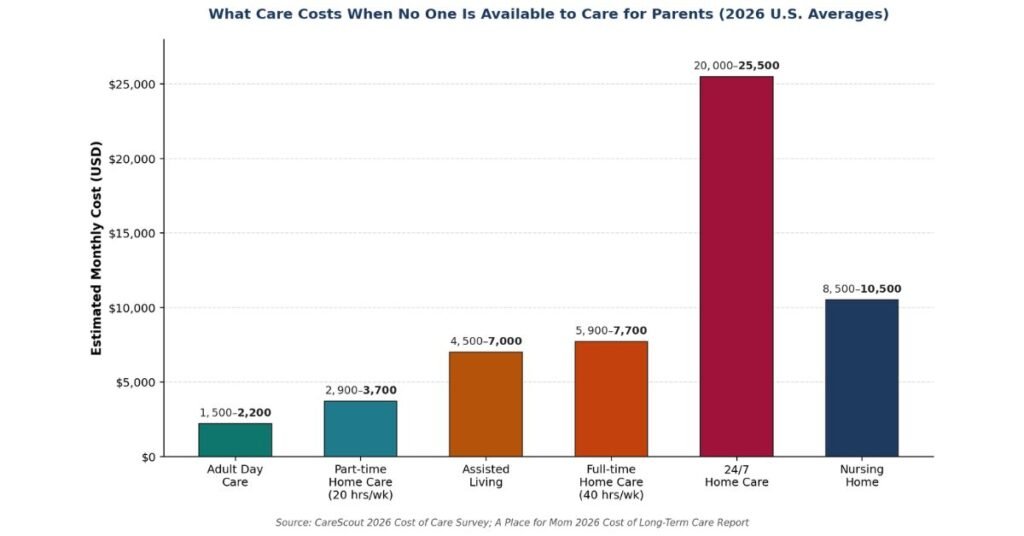
Cost is usually the deciding factor once families accept that no one is available to provide free, full-time care. Here is a realistic national breakdown.
Estimated Monthly Cost by Care Type (2026, National Averages)
| Care Type | Estimated Monthly Cost (USD) |
|---|---|
| Adult day care | $1,500 – $2,200 |
| Part-time home care (20 hrs/week) | $2,800 – $3,700 |
| Assisted living | $4,500 – $7,000 |
| Full-time home care (40 hrs/week) | $5,900 – $7,700 |
| Nursing home (semi-private room) | $8,500 – $10,500 |
| 24/7 in-home care | $20,000 – $25,500 |
The national median hourly rate for a home health aide sits around $33–$35 in 2026, though it ranges from about $25/hour in lower-cost states to over $44/hour in the most expensive ones. Around-the-clock home care often ends up costing more than a nursing home once you factor in staffing gaps, holiday rates, and home upkeep — which is why many families switch to assisted living once care needs exceed roughly 40–45 hours a week.
Government and Community Programs That Can Help
When there’s no one to care for parents and money is tight, public and nonprofit programs can close the gap. Start with these:
| Program | What It Offers | Where to Apply |
|---|---|---|
| Eldercare Locator | Free national directory connecting families to local aging services | eldercare.acl.gov |
| Area Agency on Aging (AAA) | Local case management, meal delivery, transportation, respite care | Search by ZIP code via Eldercare Locator |
| Medicaid Home & Community-Based Services (HCBS) Waivers | Covers in-home personal care for eligible low-income seniors | State Medicaid office |
| PACE Program | Combines medical and daily care to help seniors avoid nursing homes | Medicare.gov |
| VA Aid & Attendance Benefit | Extra monthly payment for wartime veterans or surviving spouses needing help with ADLs | VA.gov |
| Meals on Wheels | Daily meal delivery plus a wellness check | mealsonwheelsamerica.org |
| National Family Caregiver Support Program | Respite care and counseling, even for long-distance caregivers | Local AAA |
Note that standard Medicare does not cover long-term custodial care (help with bathing, dressing, etc.) — it only covers short-term skilled nursing or rehab after a hospital stay. Medicaid, VA benefits, long-term care insurance, or private pay are the main ways ongoing custodial care actually gets funded.
Legal and Financial Steps to Take
Even if you can’t provide hands-on care, you can — and should — put a legal and financial framework in place:
- Durable Power of Attorney (POA): Lets a trusted person manage finances and legal decisions if your parent becomes incapacitated.
- Healthcare Proxy / Medical POA: Authorizes someone to make medical decisions on your parent’s behalf.
- Advance Directive / Living Will: Documents your parent’s wishes for end-of-life care.
- Guardianship or Conservatorship: A court-appointed option if no one holds POA and your parent can no longer make decisions safely.
- Filial Responsibility Laws: More than half of U.S. states have laws that can, in limited cases, hold adult children financially responsible for a parent’s care. Rules vary widely by state, so check with an elder law attorney if you’re concerned.
An elder law attorney or your local Area Agency on Aging can walk you through which documents apply in your parent’s state.
Hiring a Geriatric Care Manager When You Can’t Be There
If distance, work, or health limits mean you truly cannot provide direct care, a geriatric care manager (Aging Life Care Professional) can be one of the most effective investments you make. These licensed professionals typically:
- Conduct an in-person needs assessment
- Recommend and vet in-home aides, facilities, or medical providers
- Attend doctor’s appointments and relay updates to family
- Monitor care quality on an ongoing basis
- Step in during emergencies so you don’t have to drop everything
Fees vary by region but often range from $100–$250 for an initial assessment and $75–$200 per hour for ongoing oversight. For many long-distance families, this cost is far lower than the value of the time, stress, and travel it saves.
Tools That Help Long-Distance Families Stay Involved
You don’t need to be in the same city to stay meaningfully involved in your parent’s care. These tools can help:
- Medical alert systems with fall detection for immediate emergency response
- Shared caregiving apps (like CareZone or Lotsa Helping Hands) to track medications, appointments, and coordinate helpers
- Video check-in calls scheduled at consistent times to catch changes early
- Smart home sensors that alert family to unusual inactivity
- Automatic bill pay and account monitoring to catch financial confusion or scams early
Coping With Guilt When You Can’t Provide Direct Care
Feeling that there’s no one to care for parents — including yourself — often comes with guilt, even when the situation is genuinely outside your control. This response is common and understandable.
A few things worth remembering:
- There is no legal requirement in most states for adult children to personally provide hands-on care — only, in some states, limited financial responsibility.
- Overwhelm is common: most caregivers report increased stress after taking on caregiving duties, which is exactly why professional support exists.
- Coordinating care is still caregiving. Hiring, managing, and overseeing paid help is a legitimate and often more sustainable form of care than trying to do everything yourself.
- Support groups and counseling help. Local Area Agencies on Aging and organizations like AARP’s caregiving resources offer free groups for people navigating exactly this situation.
Quick Action Checklist
Use this as a simple starting point today:
- Write down your parent’s current ADL and IADL needs
- Call siblings, relatives, and neighbors to confirm who can realistically help
- Contact your local Area Agency on Aging or the Eldercare Locator
- Get quotes from two or three home care agencies or nearby assisted living communities
- Check Medicaid, VA, and long-term care insurance eligibility
- Set up Power of Attorney and a healthcare proxy
- Consider a geriatric care manager if you live more than an hour away
- Schedule a support group session or counseling appointment for yourself
Frequently Asked Questions
What do you do when there’s no one to care for aging parents?
Start with a needs assessment, then contact your local Area Agency on Aging or the Eldercare Locator to find in-home care, adult day programs, or assisted living options. Set up Power of Attorney and explore Medicaid, VA benefits, or long-term care insurance to help fund the care.
Is it legal to refuse to care for an elderly parent?
In most U.S. states, adult children are not legally required to provide hands-on caregiving. However, roughly half of states have filial responsibility laws that can create limited financial obligations. Check your state’s specific rules or consult an elder law attorney.
What is the cheapest option when no family caregiver is available?
Adult day care and government-funded programs like Medicaid HCBS waivers or PACE tend to be the most affordable, especially for seniors who qualify based on income and care needs.
Does Medicare pay for a caregiver if I can’t be one?
Standard Medicare does not cover ongoing custodial care such as help with bathing or dressing. It only covers short-term skilled nursing or therapy after a hospital stay. Medicaid, VA Aid & Attendance, and long-term care insurance are the main funding sources for ongoing care.
What is a geriatric care manager and do I need one?
A geriatric care manager (Aging Life Care Professional) is a paid expert who assesses your parent’s needs, coordinates services, and monitors care quality. They’re especially useful for long-distance caregivers or families with no one locally available to manage day-to-day oversight.
Final Thoughts
Realizing there’s no one to care for parents in the way you imagined doesn’t mean your parent will go without support — it means the type of support needs to shift from informal, family-based care to a coordinated mix of professional services, community programs, and oversight. Start with an honest needs assessment, lean on your local Area Agency on Aging, and build a funding plan before a crisis forces a rushed decision. With the right structure in place, your parent can stay safe and cared for — even without a full-time family caregiver in the picture.
You may also like : Home Healthcare in India, Female Healthcare Attendant at Home, Male Healthcare Attendant at Home, Female Healthcare Attendant at Home in Delhi, Female Healthcare Attendant at Home in Noida, Female Healthcare Attendant at Home in Guragon, Male Healthcare Attendant at Home, Male Healthcare Attendant at Home in Delhi, Male Healthcare Attendant at Home in Noida


