
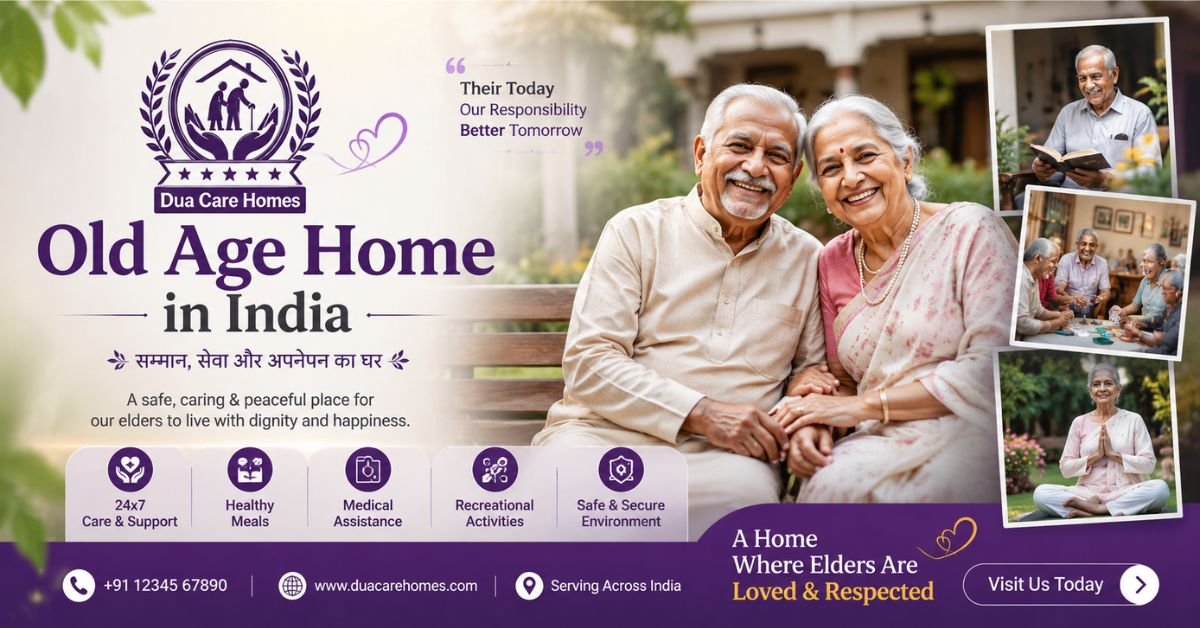
Searching for a reliable old age home for a parent or elderly relative is one of the most emotional decisions an Indian family can make. With joint families shrinking and children moving abroad for work, an old age home in India is no longer a last resort — it is a planned, loving choice. This guide breaks down types of facilities, costs, and how to identify the best old age home for your loved one, with a special focus on trusted options in UP.
What Is an Old Age Home, Really?
An old age home is a residential facility built specifically for senior citizens who need a safe, supervised, and socially active environment. It differs from a hospital in one key way: the focus isn’t on treating illness, it’s on quality of daily life — comfortable rooms, nutritious food, companionship, and medical support available whenever it’s needed.
Modern old age homes in India fall broadly into two categories:
- Charitable / NGO-run homes — free or low-cost, meant for elderly citizens with no family support or financial means.
- Private / paid old age homes — professionally staffed facilities offering personalised care, medical supervision, and better infrastructure for a monthly or yearly fee.
Most families searching for a top old age home today are looking at the second category, because it offers consistency, accountability, and trained caregiving staff — something an NGO-run shelter, however well-intentioned, often cannot guarantee at scale.
Why Old Age Homes Are Becoming Essential in India
This isn’t a niche trend anymore — it’s a demographic shift. According to the UNFPA India Ageing Report, the elderly population of India is projected to more than double by 2050, growing from roughly 149 million in 2022 to around 347 million by mid-century. The Ministry of Statistics (MoSPI) has separately noted that India’s senior citizen share will keep climbing steadily through the 2030s.
Three forces are driving demand for professional elder care in urban India:
- Nuclear families — adult children living in different cities or countries than their parents.
- Dual-income households — no one available at home during working hours to provide daily supervision.
- Rising life expectancy — more seniors living with age-related mobility issues, chronic illness, or memory conditions that require trained attention, not just companionship.
Government data from the World Bank confirms that India’s 65+ population share has been rising consistently for over a decade — a trend that shows no sign of reversing. This is precisely why demand for a dependable old age home has grown across metro cities and NCR towns alike.
Types of Old Age Homes in India: A Quick Comparison
Not every old age home offers the same level of care. Before shortlisting names, it helps to understand what each category actually provides.
| Type of Facility | Who It’s For | Typical Monthly Cost (INR) | Medical Support |
|---|---|---|---|
| Charitable / NGO Old Age Home | Elderly with no family or financial support | Free to ₹5,000–8,000 | Basic, often limited |
| Standard Paid Old Age Home | Independent seniors needing a safe, social living space | ₹15,000–35,000 | On-call, periodic check-ups |
| Senior Assisted Living Facility | Seniors needing daily help with bathing, mobility, medication | ₹30,000–90,000 | 24/7 nursing + doctor-on-call |
| Luxury Retirement Community | Independent, financially secure seniors wanting resort-style living | ₹66,500 and above | Varies by project |
Costs are indicative and vary by city, room type, and level of care required — always request a transparent, written breakdown before enrolling a family member anywhere.
How to Identify the Best Old Age Home: A Practical Checklist
Choosing the best old age home isn’t about the fanciest brochure — it’s about what happens on an ordinary Tuesday afternoon when nobody’s watching. Use this checklist while shortlisting:
- Medical readiness — Is there 24/7 nursing staff and a doctor-on-call arrangement, not just a tie-up on paper?
- Staff-to-resident ratio — A lower ratio means faster response times and more personal attention.
- Hygiene and safety — Fall-prevention flooring, CCTV coverage, wide corridors, and lift access are non-negotiable.
- Personalised care plans — Every senior has different mobility, dietary, and medical needs; a one-size-fits-all package is a red flag.
- Transparent pricing — No hidden charges, clear admission terms, and a written service agreement.
- Family communication policy — Regular updates, open visiting hours, and video-call access for NRI families.
- In-person visit before enrolment — Never finalise a facility without physically visiting and speaking to current resident families.
A genuinely top old age home will never hesitate to let you walk in unannounced, meet the caregiving staff, and speak candidly with residents.
Old Age Home in UP: A Growing Need Across Noida, Ghaziabad, and NCR
Uttar Pradesh has traditionally had a younger population profile compared to southern states, but that is changing fast in its urbanised NCR belt. Sectors across Noida, Ghaziabad, and Greater Noida have seen rapid migration of working professionals whose parents remain nearby — creating strong, steady demand for a reliable old age home in UP that combines medical readiness with a homely atmosphere.
Families in this region are typically looking for one of three things:
- Short-term or respite care while they travel or manage a medical emergency elsewhere.
- Long-term residential care for a parent who can no longer live safely alone.
- Specialised care for conditions like dementia, paralysis, post-surgery recovery, or bedridden support.
Unlike Delhi’s saturated senior-living market, UP-based old age homes in Noida and the surrounding NCR belt often offer more spacious campuses, better price-to-facility ratios, and easier accessibility for family visits from across the region — an important, practical advantage for families juggling work and caregiving.
Introducing Dua Old Age Caring Institution — A Trusted Old Age Home in Noida, UP

Among the facilities serving the NCR region, Dua Old Age Caring Institution has built a strong reputation as a genuinely dependable old age home in Noida, UP, with additional service reach across Gurgaon, Ghaziabad, and Delhi-NCR.
Established in 2018, Dua has grown into a full-service elder care institution that has supported over 20,000 seniors through a team of 50+ trained professionals. Rather than treating residents as patients, Dua positions every senior as a valued family member — a philosophy reflected in the way its care model, called DUA (Daily Use Assistance), is structured around dignity-first daily support.
What Makes Dua’s Care Model Different
Dua’s Daily Use Assistance program focuses on the everyday realities of ageing that families often underestimate until they’re living through them:
- Bathroom and grooming support — hygiene assistance delivered respectfully and privately.
- Dressing assistance — help selecting and wearing appropriate clothing with ease.
- Eating support — mealtime assistance for residents who need feeding help or encouragement.
- Mobility assistance — safe movement across the premises, including wheelchair and bed-to-chair transfers.
- Medication reminders — timely, accurate medicine intake through caregiver oversight.
This isn’t generic supervision — it’s structured, resident-specific daily care, which is exactly what separates a genuinely top old age home from a facility that only offers a bed and basic meals.
Dua’s In-House Care Team Structure
Quality elder care is a team effort, not a single caregiver’s job. Dua’s layered staffing model is one of the clearest signs of its commitment to accountable care:
| Role | Responsibility |
|---|---|
| In-House Doctor | Daily health observation, early detection of concerns, evolving care plans |
| Staff Nurse | Medication schedules, vitals tracking, wound and post-procedure care |
| Coordinator | Mobility support oversight and residents’ social wellbeing |
| Caregiver / GDA | Personal hygiene and daily living assistance with patience and dignity |
| On-Call Doctor | Specialist consultations when required |
| On-Call Physiotherapist | Post-surgery recovery and mobility rehabilitation |
Services Offered at Dua Old Age Caring Institution
Dua’s service range extends well beyond standard old age home care, covering medically complex situations that many facilities in UP simply aren’t equipped to handle:
- Assisted Living Facility (bathing, dressing, mobility, meals)
- Memory Care — Dementia, Alzheimer’s, and Parkinson’s support
- Bedridden and Paralysis Care
- Pre & Post-Surgery Care, including stroke, trauma, coma, and cancer patient care
- Physiotherapy and rehabilitation support
- NRI Elder Parents Care with WhatsApp and video-call health updates
- Retirement homes and senior resident care for independent seniors
Why Families Choose Dua as Their Old Age Home in UP
Several practical factors explain why Dua has become one of the go-to names for families searching for a best old age home in the Noida–Gurgaon–Ghaziabad belt:
- Round-the-clock medical supervision with in-house nursing and doctor-on-call systems.
- Personalised meal plans — diabetic-friendly, low-sodium, soft-diet, or religious dietary preferences, prepared fresh daily.
- Transparent pricing with no hidden costs, discussed openly during the admission consultation.
- Multiple NCR locations — Noida, Gurgaon, Ghaziabad, and Delhi-NCR — for convenient family access.
- Genuine home-like environment with festival celebrations, yoga, group activities, and daily social interaction.
- Dedicated NRI support, including remote admission processes and regular video updates for families living abroad.
Families exploring a top old age home in UP are encouraged to visit Dua’s Noida facility in person, meet the in-house care team, and see the daily routine firsthand before making a decision. You can learn more or schedule a consultation directly at duaoldagecaringinstitution.com.
Old Age Home vs. Senior Assisted Living vs. Home Care: Which One Is Right?
This is one of the most common points of confusion for families, so here’s a direct, side-by-side comparison to simplify the decision.
| Feature | Old Age Home | Senior Assisted Living | In-Home Nursing Care |
|---|---|---|---|
| Best suited for | Independent seniors wanting community living | Seniors needing daily hands-on support | Seniors who refuse to leave their own house |
| Medical supervision | Basic to periodic | 24/7 nursing + doctor-on-call | Depends on hired staff |
| Social interaction | High (community setting) | High, structured activities | Low to none |
| Cost predictability | Moderate, transparent packages | Moderate to high, but bundled | Variable, can spike with emergencies |
| Emergency response | Facility-managed | Facility-managed, faster response | Family-managed, slower |
| Family involvement needed | Low | Low | High |
As this table shows, senior assisted living — the model Dua Old Age Caring Institution specialises in — sits at the sweet spot for families who want professional-grade medical readiness without sacrificing the community warmth of a traditional old age home.
Common Mistakes Families Make When Choosing an Old Age Home
Even well-meaning families get this decision wrong sometimes. Watch out for these avoidable mistakes:
- Deciding based on photos alone — Always visit in person before enrolling.
- Ignoring the staff-to-resident ratio — A beautiful building with understaffed care is a serious risk.
- Not asking about emergency protocols — Ask exactly what happens if a resident falls at 2 AM.
- Overlooking dietary flexibility — Diabetic, low-sodium, or religious meal needs must be confirmed upfront.
- Skipping the written agreement — Verbal promises about pricing or services mean nothing without documentation.
Helping a Parent Transition Emotionally to an Old Age Home
The logistics of choosing a facility are only half the challenge — the emotional transition matters just as much, both for the senior and for the family making the decision.
Many seniors initially resist the idea of moving into an old age home, often out of fear of being “sent away” rather than genuine reluctance about the facility itself. A few practical steps can make this transition smoother:
- Involve them in the decision — Take your parent along for facility visits instead of presenting the move as already decided.
- Start with a short-term stay — A respite or trial stay lets seniors experience the environment without the pressure of a permanent decision.
- Frame it as added independence, not loss — Emphasise the community, activities, and companionship rather than the medical supervision alone.
- Stay consistently involved — Regular visits and calls reassure seniors that the move isn’t a disconnection from family, but an extension of it.
Facilities that actively support this emotional transition — through open visiting policies, family orientation sessions, and gradual settling-in periods — tend to see far better long-term adjustment among residents than those that simply process admissions and move on.
The Role of Government Policy in Elder Care
India’s policy framework for senior citizens has strengthened considerably over the past two decades, and understanding it helps families see old age homes within a broader support system rather than as an isolated private service.
The Maintenance and Welfare of Parents and Senior Citizens Act, 2007 legally obligates children to provide for their elderly parents, while schemes such as the National Programme for Health Care of the Elderly (NPHCE) and Atal Vayo Abhyuday Yojana (AVYAY) aim to expand healthcare access and welfare infrastructure for seniors nationwide. These policies reflect a growing national recognition that elder care — whether provided at home or through a professional facility — is a shared societal responsibility, not just a family’s private burden.
For families in UP specifically, this policy backdrop is significant. As NCR towns like Noida and Ghaziabad continue to urbanise faster than the rest of the state, demand for professionally regulated, accountable old age homes is likely to keep rising well ahead of the state’s overall ageing curve.
Frequently Asked Questions About Old Age Homes in India
1. What is the difference between an old age home and a nursing home?
An old age home focuses on daily living, companionship, and light medical supervision for largely independent seniors. A nursing home is built for patients who need continuous, intensive medical treatment and monitoring.
2. How much does a good old age home in India cost?
Costs vary widely — charitable homes may be free, while paid old age homes and assisted living facilities typically range from ₹15,000 to ₹90,000 per month, depending on the city, room type, and level of medical care required.
3. Is Noida a good location for an old age home in UP?
Yes. Noida offers a strong combination of medical infrastructure, connectivity across NCR, and more spacious, better-priced facilities compared to central Delhi — making it a practical choice for families across UP and the wider NCR region.
4. Can NRI families enrol a parent remotely?
Reputable facilities, including Dua Old Age Caring Institution, offer remote consultations, digital document submission, and regular video updates so NRI families can complete admissions and stay informed without visiting in person.
5. What documents are usually required for admission?
Most old age homes require identity proof (Aadhaar or Passport), recent medical reports, a doctor’s recommendation (if applicable), emergency contact details, and a guardian or family member’s ID proof.
6. How do I know if a facility offers genuine 24/7 medical care?
Ask directly whether nurses are physically on-site around the clock or only on-call, and confirm how quickly a doctor can be reached during an emergency — this single question separates a genuinely medically-ready facility from one that only claims to be.
7. Are old age homes only for seniors without family support?
No. Today, most residents have loving families who simply cannot provide round-the-clock supervision due to work, distance, or the senior’s specific medical needs — an old age home is a support system, not a replacement for family.
Conclusion: Making the Right Choice for Your Loved One
Choosing the best old age home for a parent or elderly relative is never purely a logistical decision — it’s an act of care that deserves the same diligence you’d apply to any major life decision. Focus on medical readiness, transparent pricing, staff quality, and genuine warmth over glossy marketing.
For families across Noida, Gurgaon, Ghaziabad, and the wider NCR — including much of UP — Dua Old Age Caring Institution has built its reputation on exactly these fundamentals: a trained in-house medical team, personalised daily care, transparent pricing, and a genuinely home-like environment for every resident.
If you’re evaluating a top old age home in India or specifically searching for a dependable old age home in UP, reach out to Dua Old Age Caring Institution to schedule a visit, meet the caregiving team, and see the difference compassionate, professional elder care makes.
📞 Contact: +91 9870110433 | 🌐 Website: duaoldagecaringinstitution.com | 📍 Address: D-15, Sector 63A, Noida, UP 201301
Follow Us On : Facebook, Twitter, Instagram
You May Like : Old Age Home, Best Old Age Home, Old Age Home in Noida


