

India is home to over 157 million senior citizens, and that number keeps climbing every year, making reliable elder care solutions harder to find and more urgent to plan for. Nuclear families, overseas careers, and demanding city jobs mean fewer households have someone home during the day to look after ageing parents. This guide breaks down the real challenges behind elder care in India, walks through every category of elder care solutions available today — from home nursing to assisted living — and shows how to choose services that genuinely protect your parents’ health, safety, and dignity, wherever in the world you live.
Understanding Elder Care in India Today
Elder care means the medical, physical, and emotional support that senior citizens need to live safely and comfortably as they age. In India, this used to be handled entirely within joint families. That model is fading fast.
Nuclear households, children working abroad, and demanding urban jobs mean fewer families have someone home during the day. As a result, professional elder care — home nursing, assisted living, old age homes, and specialised medical care — has grown from a niche service into an essential part of Indian family life.
India’s Ageing Population: Key Numbers
The scale of this shift becomes clear when you look at the data. According to the Longitudinal Ageing Study in India, Indians aged 60 and above number approximately 157 million in 2026, about 10.8 percent of the population. That share is expected to keep rising sharply over the coming decades.
| Metric | Figure | Source Year |
|---|---|---|
| Population aged 60+ in India | ~157 million (10.8% of population) | 2026 |
| Projected share aged 60+ by 2050 | Expected to reach 347 million people | 2050 |
| Share of population aged 60+ by 2036 | Nearly one in seven Indians (about 230 million people) | 2036 |
| Growth rate of population aged 80+ | Around 279% growth between 2022 and 2050 | 2022–2050 |
| Elderly living independently (alone or with spouse only) | 26 percent of older adults, rising toward 60 million by 2045 | Current–2045 |
This is why elder care solutions in India are shifting from an informal, family-only approach to a structured mix of home care, assisted living, and residential facilities.
Major Challenges in Elder Care in India
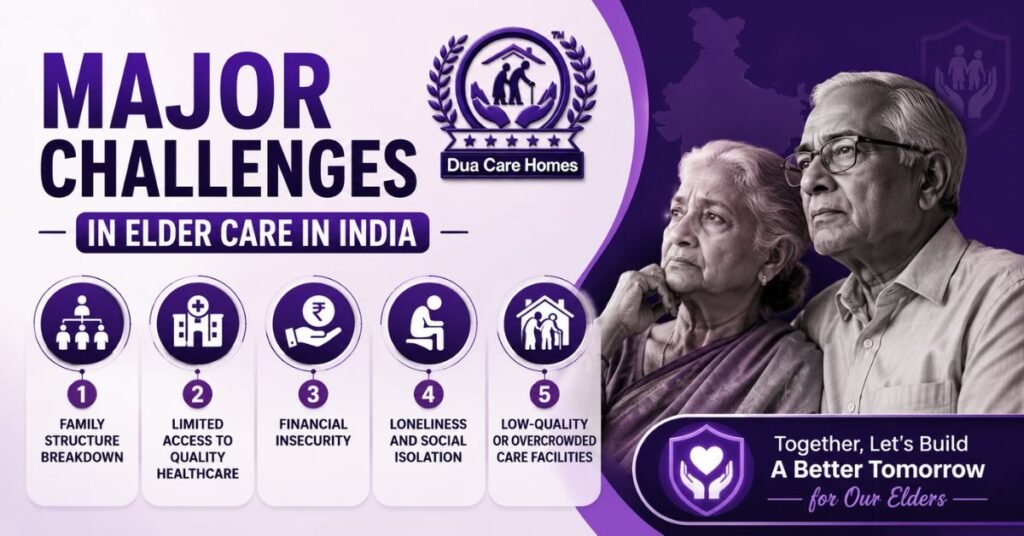
Elder care in India doesn’t struggle because families don’t care. It struggles because of structural gaps in support, awareness, and infrastructure. Here are the challenges families run into most often.
1. Family Structure Breakdown
Joint families once guaranteed round-the-clock support for elders. Today, adult children frequently live in different cities or countries. This leaves many seniors managing daily life, medication, and emergencies largely alone.
2. Limited Access to Quality Healthcare
Geriatric specialists remain concentrated in metro cities. Rural and even many urban seniors face long travel times, overcrowded hospitals, and a shortage of doctors trained specifically in age-related conditions like dementia, arthritis, and cardiovascular disease.
3. Financial Insecurity
Pension coverage in India remains thin outside the organised sector. Many elderly citizens depend entirely on family support or minimal state assistance, making private long-term care financially difficult without proper planning.
4. Loneliness and Social Isolation
The rise of nuclear family culture and children moving away for work or marriage results in isolation among older people. Isolation is now recognised as a serious risk factor for depression, cognitive decline, and poor physical health among seniors.
5. Low-Quality or Overcrowded Care Facilities
Many public or charitable old-age homes generally offer substandard living conditions, lacking basic sanitation and essential services, and overcrowding means bedridden or critically ill older adults are often turned away. This gap has pushed demand toward better-run, professionally managed private facilities.
6. Lack of Awareness About Available Support
Most families don’t know that structured government schemes, legal protections, and professional home-care options already exist. This gap in awareness often delays families from getting help until a health crisis forces the decision.
| Challenge | Impact on Families |
|---|---|
| Nuclear family shift | No one available for daily supervision |
| Healthcare access gaps | Delayed diagnosis, emergency risk |
| Financial insecurity | Limited access to quality private care |
| Isolation & loneliness | Higher risk of depression, cognitive decline |
| Overcrowded facilities | Poor hygiene, inadequate medical response |
| Low awareness | Families act only after a crisis |
Elder Care Solutions in India: Types of Services Available
The good news is that elder care solutions in India have matured significantly over the past decade. Families now have several structured options depending on the senior’s health, mobility, and independence level.
Home Care Services
Trained caregivers or nurses visit the senior’s own home to help with bathing, dressing, medication, mobility, and companionship. This suits seniors who are largely independent but need daily supervision or medical monitoring.
Assisted Living Facilities
Assisted living blends independence with hands-on help. Seniors live in a residential facility with private or semi-private rooms, while trained staff manage medication schedules, mobility support, meals, and daily hygiene routines around the clock.
Old Age Homes / Residential Senior Care
Old age homes provide shelter, nutritious meals, safety, and companionship for seniors who are largely independent but prefer a community setting with built-in supervision, rather than living alone.
Memory and Dementia Care
Specialised care for residents with Alzheimer’s, dementia, or Parkinson’s disease. This includes secure environments, trained staff for cognitive support, and structured daily routines that reduce confusion and anxiety.
Post-Surgery and Medical Recovery Care
Short-term, medically supervised care for seniors recovering from surgery, stroke, fractures, or hospitalisation — including physiotherapy, wound care, and step-down support after an ICU stay.
NRI Elder Parent Care
Designed for adult children living abroad. These services provide regular health updates, video check-ins, and full on-ground supervision so families overseas stay informed and reassured about their parents’ wellbeing.
Signs Your Parents May Need Professional Elder Care
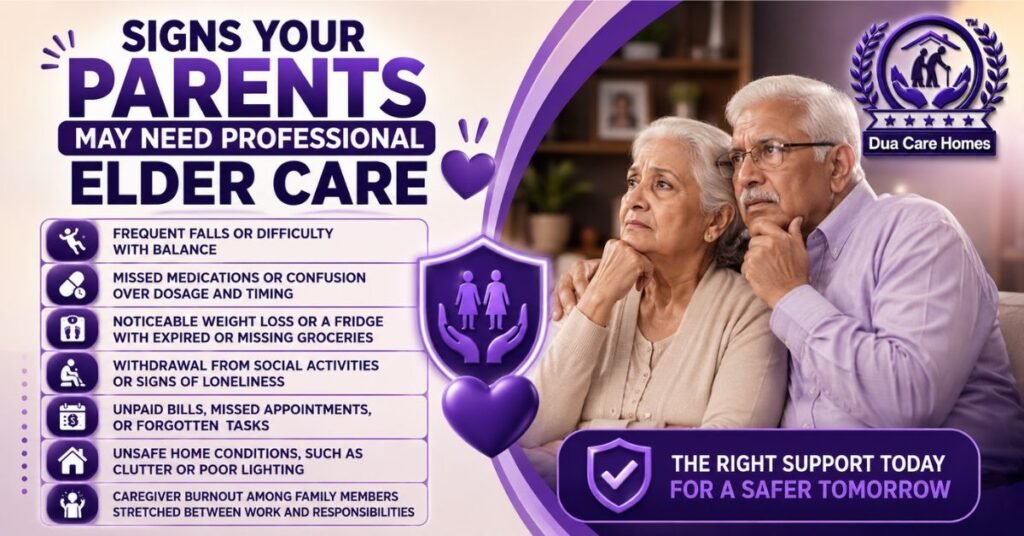
Many families delay the decision until a health emergency forces their hand. Watching for early signs can help you choose the right elder care solution proactively, rather than reactively.
- Frequent falls or difficulty with balance while walking, standing, or climbing stairs.
- Missed medications or confusion over dosage and timing.
- Noticeable weight loss or a fridge with expired or missing groceries.
- Withdrawal from social activities they once enjoyed, or signs of persistent loneliness.
- Unpaid bills, missed appointments, or forgotten tasks that suggest early cognitive decline.
- Unsafe home conditions, such as clutter, poor lighting, or no support rails in the bathroom.
- Caregiver burnout among family members who are already stretched between work and other responsibilities.
If two or more of these signs sound familiar, it’s a reasonable moment to start researching elder care solutions rather than waiting for a crisis.
The Emotional Side of Choosing Elder Care
Deciding on professional care for a parent is rarely just a logistics decision — it often comes with guilt, hesitation, and cultural pressure around “sending parents away.” It helps to reframe this early.
Professional elder care isn’t a replacement for family love; it’s a support system that makes that love sustainable. A trained caregiver handling medication schedules, mobility support, and emergency response frees up family time for what actually matters — conversation, companionship, and presence, rather than exhausted caregiving.
Involve your parents in the decision wherever possible. Visit facilities together, ask about daily routines, and let them meet the care team before committing. Seniors who feel consulted, rather than decided-for, tend to adjust far better to any new care arrangement — whether that’s a caregiver at home or a move to an assisted living facility.
Comparison: Home Care vs. Assisted Living vs. Old Age Home
Choosing between these three models depends heavily on the senior’s health condition and daily support needs. Here’s a side-by-side comparison to simplify the decision.
| Feature | Home Care | Assisted Living | Old Age Home |
|---|---|---|---|
| Setting | Senior’s own residence | Dedicated facility | Dedicated facility |
| Best suited for | Mostly independent seniors | Seniors needing daily support | Independent, social seniors |
| Medical supervision | Visit-based | Round-the-clock | Basic to moderate |
| Social interaction | Limited | High (community living) | High (community living) |
| Cost structure | Pay per shift/hour | Monthly package | Monthly package |
| Family involvement | Direct daily contact | Regular visits | Regular visits |
There’s no universally “best” option — the right choice depends on medical needs, budget, and how much daily supervision the senior genuinely requires.
Government Schemes Supporting Elder Care in India
Alongside private care services, the Indian government runs several schemes to support senior citizens, particularly economically vulnerable ones. Families should know these exist, even if they ultimately choose private care.
| Scheme / Policy | What It Offers |
|---|---|
| Maintenance and Welfare of Parents and Senior Citizens Act, 2007 | Legal framework requiring children to provide maintenance and support for elderly parents |
| Atal Vayo Abhyudaya Yojana (AVYAY) | Umbrella programme improving living standards of senior citizens, including assistive devices and welfare schemes |
| Rashtriya Vayoshri Yojana (RVY) | Free assistive living devices for BPL senior citizens |
| Ayushman Bharat – PMJAY (2024 Expansion) | Additional ₹5 lakh health coverage for senior citizens aged 70 and above |
| National Programme for Health Care of the Elderly (NPHCE) | Geriatric care services delivered at district and sub-district health levels |
| Elderline (National Helpline 14567) | Free information, counselling, emotional support, and field services for elder needs including abuse and legal advice |
| SACRED Portal | Digital platform connecting senior citizens with private-sector employment opportunities |
You can check current eligibility and updates directly on the Government of India’s Department of Social Justice and Empowerment website and read more on ageing trends via UNFPA India’s ageing reports.
How to Choose the Right Elder Care Solution
Selecting a care option shouldn’t be rushed. Use this checklist to evaluate any facility or home-care provider before committing.
- Assess medical needs first. Does your parent need daily medical supervision, or mainly companionship and safety supervision?
- Check staff qualifications. Ask about nurse-to-resident ratios, doctor availability, and background verification of caregivers.
- Visit in person. Photos and websites don’t reveal hygiene standards, food quality, or how staff actually treat residents.
- Review pricing transparency. A trustworthy provider explains all costs upfront — no hidden charges for basic care.
- Confirm emergency protocols. Ask exactly what happens during a medical emergency, including hospital tie-ups and response time.
- Evaluate communication systems. For NRI families especially, regular updates through calls, video, or apps are non-negotiable.
- Read real family reviews. Speak with existing resident families wherever possible before making a final decision.
Why Families Trust Dua Old Age Caring Institution

Among the growing number of elder care solutions across the Delhi-NCR region, Dua Old Age Caring Institution has built its reputation on structured, medically backed, and genuinely compassionate care.
Operating from Noida with presence across Gurgaon, Ghaziabad, and Delhi-NCR, Dua Old Age Caring Institution combines residential comfort with real clinical oversight — not just basic supervision.
What Sets Dua Apart
- Layered care team: In-house doctor, staff nurse, dedicated coordinator, and trained caregivers, backed by on-call specialists and physiotherapists.
- DUA – Daily Use Assistance: A dedicated framework covering bathing, grooming, dressing, feeding, mobility, and medication reminders with dignity and patience.
- Medical readiness: 24/7 nursing staff, doctor-on-call arrangements, and coordinated emergency response systems.
- Personalised meal planning: Diabetic-friendly, low-sodium, and religious dietary preferences prepared fresh daily.
- Recreational and emotional wellbeing: Yoga, festival celebrations, music sessions, and group activities that keep residents socially engaged.
- NRI-friendly support: Regular WhatsApp updates, video calls, and remote admission assistance for families living abroad.
- Specialised medical care: Dementia, Alzheimer’s, Parkinson’s, stroke, paralysis, bedridden, and post-surgery care available under one roof.
Families exploring an old age home in Noida or senior assisted living in Gurgaon can schedule a visit directly through Dua Old Age Caring Institution’s website to see the facility, meet the care team, and get transparent pricing before making a decision.
Frequently Asked Questions
Q1. What are the best elder care solutions available in India today?
The main options are home care services, assisted living facilities, old age homes, memory care units, and specialised post-surgery care — the right choice depends on the senior’s health condition and independence level.
Q2. Is professional elder care expensive in India?
Costs vary widely based on the service type, city, and level of medical supervision required. Home care is generally billed per shift, while assisted living and old age homes usually charge monthly packages with transparent pricing.
Q3. How do I know if my parents need assisted living instead of home care?
If your parent needs daily help with mobility, medication management, or has a chronic condition requiring regular monitoring, assisted living typically offers safer, more consistent support than home care alone.
Q4. Are government elder care schemes available to everyone?
Some schemes, like Rashtriya Vayoshri Yojana, are targeted at economically vulnerable senior citizens, while others, such as Ayushman Bharat–PMJAY coverage for those 70+, are broadly available. Check the official government portal for current eligibility.
Q5. Can NRI families manage elder care for parents living in India?
Yes. Many facilities, including Dua Old Age Caring Institution, offer remote admission processes, regular health updates, and video communication specifically designed for families living abroad.
Q6. What legal protections exist for elderly parents in India?
The Maintenance and Welfare of Parents and Senior Citizens Act, 2007 provides a legal framework requiring adult children to support their elderly parents, along with protections against abandonment and abuse.
Conclusion: Elder Care Is a Decision Rooted in Dignity
India’s ageing population is growing faster than most families realise, and the challenges — isolation, healthcare gaps, and financial pressure — are real. But so are the solutions. Between government schemes, home care, assisted living, and dedicated residential facilities, families today have more structured, professional options than ever before.
Choosing the right elder care solution isn’t about finding the cheapest option — it’s about finding a team that treats your parents the way you would. Facilities like Dua Old Age Caring Institution exist precisely for that reason: to give families across Noida, Gurgaon, and Delhi-NCR a place where their elders receive medical reliability, daily comfort, and genuine emotional care — all under one roof.
If you’re evaluating elder care options for your family, the best next step is simple: visit a facility, ask the hard questions, and choose care that feels like an extension of home, not a replacement for it.
Follow Us On : Facebook, Twitter, Instagram
You May Like : Old Age Home, Best Old Age Home, Old Age Home in Noida
