

Growing older is a journey that no one should have to walk alone. As families across India become busier, more spread out, and increasingly global, the question of how to care for aging parents has become one of the most important — and most emotional — decisions a family will ever face.
An old age home is no longer the last resort it was once seen as. Today, it is a considered, responsible choice made by loving families who want their elders to live safely, comfortably, and with dignity, even when round-the-clock home care isn’t possible. Dua Old Age Caring Institution, based in Sector 63A, Noida, has spent years building exactly that kind of home — one where seniors are cared for like family, not just residents.
This guide walks through everything you need to know before choosing an old age home in Noida: what to look for, what daily life looks like, what it costs, and how Dua approaches elder care differently.
What Is an Old Age Home, and Why Are More Families Choosing One?
An old age home — also called a senior living facility, retirement home, or elder care home — is a residential facility built specifically for senior citizens. It combines accommodation, meals, medical supervision, and companionship under one roof, so elders don’t have to manage daily life alone and families don’t have to choose between their careers and their parents’ wellbeing.
India’s demand for quality old age homes has grown sharply in the last decade, driven by a few clear shifts:
- Nuclear families have become the norm. Joint family systems that once meant elders were never alone are far less common today, especially in cities like Noida and Delhi NCR.
- NRI families need a trustworthy option. Adult children living abroad often can’t be physically present, and want their parents in a place with transparent communication and reliable medical support.
- Medical complexity is increasing. Conditions like dementia, Parkinson’s, paralysis, or post-surgical recovery often require specialised care that’s genuinely difficult to manage at home without trained staff.
- Working professionals have limited time. Long hours in corporate hubs like Noida make consistent, hands-on elder care hard to sustain, even with the best intentions.
Choosing an old age home isn’t about giving up on caregiving — it’s about extending it through people and systems built for exactly that purpose.
Signs It Might Be Time to Consider an Old Age Home
Families often feel guilt or hesitation even when the need is clear. If any of the following sound familiar, it may be worth exploring a professional care facility:
- Your parent frequently forgets medication or misses doctor’s instructions
- There have been repeated falls, mobility issues, or unexplained injuries
- They seem increasingly isolated, withdrawn, or lonely during the day
- Daily tasks like bathing, dressing, or cooking have become genuinely difficult
- A recent hospitalisation, stroke, or diagnosis now requires ongoing supervision
- You’ve noticed a decline in hygiene, nutrition, or general home upkeep
Recognising these signs early — rather than waiting for a crisis — usually leads to a smoother transition and a better outcome for everyone involved.
Types of Old Age Homes in India
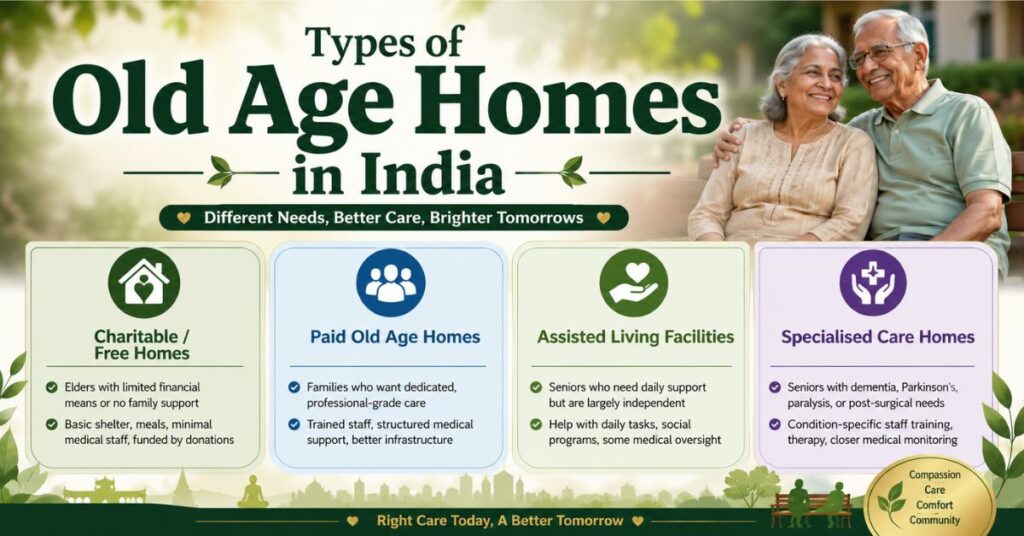
Not all old age homes serve the same purpose. Understanding the categories helps families match the right facility to the right need:
| Type | Best For | What to Expect |
|---|---|---|
| Charitable / Free Homes | Elders with limited financial means or no family support | Basic shelter, meals, minimal medical staff, funded by donations |
| Paid Old Age Homes | Families who want dedicated, professional-grade care | Trained staff, structured medical support, better infrastructure |
| Assisted Living Facilities | Seniors who need daily support but are largely independent | Help with daily tasks, social programs, some medical oversight |
| Specialised Care Homes | Seniors with dementia, Parkinson’s, paralysis, or post-surgical needs | Condition-specific staff training, therapy, closer medical monitoring |
Dua Old Age Caring Institution operates as a paid, professionally staffed facility with specialised care capability, meaning residents get both the comfort of assisted living and the medical depth needed for more complex conditions — without needing to be moved between facilities as needs change.
What to Look for Before Choosing an Old Age Home
Not every facility that calls itself an old age home offers the same standard of care. Before shortlisting, evaluate on these criteria:
- Medical readiness – Is there 24/7 nursing staff? How quickly can a doctor be reached in an emergency?
- Staff-to-resident ratio – Understaffed homes struggle to provide individual attention, especially for bedridden or high-dependency residents.
- Physical safety – Anti-slip flooring, handrails, lifts (not just stairs), wide corridors, and functioning emergency call systems.
- Specialised care capability – Can they actually manage dementia, stroke recovery, or palliative needs, or do they only offer general supervision?
- Communication with families – Especially important for NRI families: are updates proactive, or do you have to chase for them?
- Hygiene and food quality – Visit during a mealtime if possible, and ask about dietary customisation for diabetes, hypertension, or renal conditions.
- Transparent pricing – A trustworthy facility will give you a clear cost breakdown upfront, not vague ranges that expand later.
A short visit rarely reveals all of this — ask to speak with current residents’ families if the facility allows it.
About Dua Old Age Caring Institution

Dua Old Age Caring Institution is located at D-15, Sector 63A, Noida, Uttar Pradesh 201301, close to major hospitals and residential areas, making it easily accessible for families visiting from across Delhi NCR.
Since opening, Dua has focused on one core idea: elder care should feel like an extension of family, not a departure from it. That shows up in three practical ways —
- Medical depth: The facility supports residents with genuinely complex needs, including dementia, Parkinson’s, post-stroke rehabilitation, paralysis, and palliative care — not just general supervision.
- Consistent communication: Families, including NRIs, receive regular health updates through calls, WhatsApp, and video visits, so distance doesn’t mean disconnect.
- A structured, engaged daily routine: Residents follow a day built around movement, nutrition, therapy, and genuine social interaction — not just meals and rest.
Core Services at Dua Old Age Caring Institution
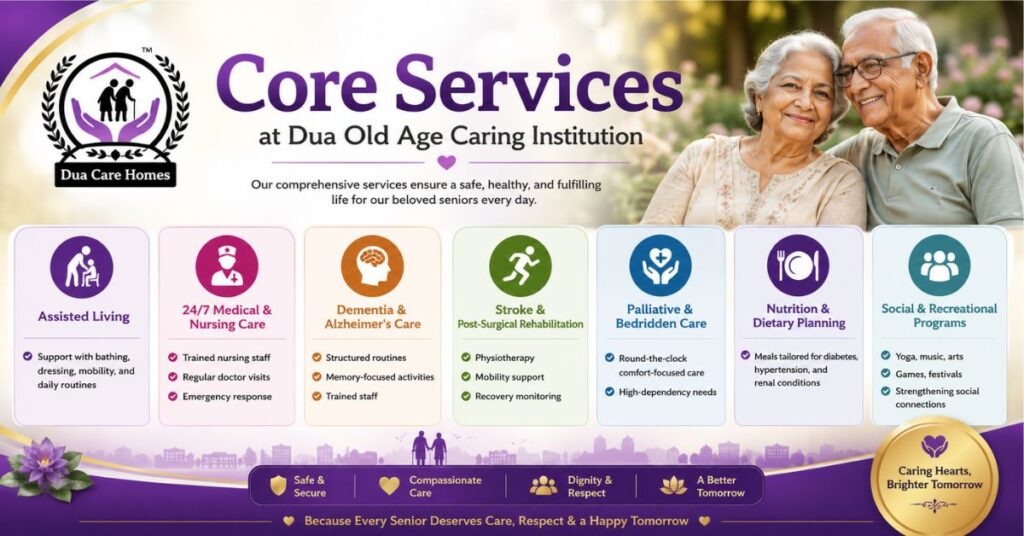
| Service | What It Includes | Who It’s For |
|---|---|---|
| Assisted Living | Support with bathing, dressing, mobility, and daily routines | Seniors who need daily help but want to retain independence |
| 24/7 Medical & Nursing Care | Trained nursing staff, regular doctor visits, emergency response | All residents, especially those with ongoing health conditions |
| Dementia & Alzheimer’s Care | Structured routines, memory-focused activities, trained staff | Residents with cognitive decline or memory-related conditions |
| Stroke & Post-Surgical Rehabilitation | Physiotherapy, mobility support, recovery monitoring | Residents recovering from stroke, surgery, or paralysis |
| Palliative & Bedridden Care | Round-the-clock comfort-focused care | Residents with advanced-stage or high-dependency needs |
| Nutrition & Dietary Planning | Meals tailored for diabetes, hypertension, and renal conditions | All residents, personalised by health condition |
| Social & Recreational Programs | Yoga, music, arts, group games, festive celebrations | Residents who benefit from structured social engagement |
Every plan is built around the individual resident’s health status, not a one-size-fits-all package — which is why the intake process always begins with a proper medical and lifestyle assessment.
A Day in the Life at Dua
Structure matters for elder wellbeing — both physically and mentally. A typical day at Dua includes:
- Morning wellness: Gentle stretching or yoga to start the day
- Nutritious, doctor-approved meals: Planned around individual dietary needs
- Therapy sessions: Physiotherapy or rehabilitation, individually or in small groups
- Social engagement: Storytelling, music, art, and group games
- Outdoor time: Supervised walks in safe, landscaped outdoor spaces
- Evening wind-down: Group prayers, meditation, or quiet time, with staff support available as needed
The goal isn’t just to fill the day — it’s to give residents a rhythm that keeps them physically active and mentally engaged.
Safety and Security
For most families, safety is the single biggest factor in choosing a facility. At Dua, this includes:
- Emergency call bells and alert systems throughout the facility
- Staff trained specifically in emergency response and timely medication administration
- Anti-slip flooring, handrails, lifts, and wide corridors designed for fall prevention
- Monitored access control and CCTV coverage across common areas
If you’re evaluating any facility, ask specifically how they’d handle a fall, a sudden medical event, or a night-time emergency — the answer tells you a lot about how seriously safety is actually built into daily operations, not just listed as a feature.
The Admission Process
Dua keeps the process deliberately simple, since families are often already managing a stressful transition:
- Initial consultation – A full assessment of the senior’s health status and specific care needs
- Personalised care plan – Built from that assessment, covering medical, dietary, and daily-support requirements
- Documentation support – Assistance with identity documents, medical history, and emergency contacts
- Move-in and settling-in support – Staff help residents adjust, with families kept informed throughout
- Ongoing family engagement – Scheduled updates, virtual visits, and open communication channels, especially for NRI families
What Does an Old Age Home in Noida Cost?
Cost is one of the most common — and most avoided — questions families have. Being upfront about it builds trust rather than eroding it. Pricing for old age homes in Noida generally varies based on:
- Room type – Shared vs. private accommodation
- Level of medical care required – General supervision vs. specialised nursing (e.g., dementia or bedridden care)
- Additional therapies – Physiotherapy, dietary consultations, or rehabilitation programs
- Duration of stay – Short-term respite care vs. long-term residency
For an accurate quote based on your specific care needs, contact Dua directly at +91 98701 10433 or info@duaoldagecaringinstitution.com.
Old Age Home vs. Home Care: Which Is Right for Your Parent?
Many families default to hiring a home nurse or attendant without fully weighing it against a dedicated facility. Both can work well — the right choice depends on the specific situation.
| Factor | Home Care | Old Age Home |
|---|---|---|
| Medical emergencies | Depends on one attendant’s response time | Trained staff and doctors on-site or on-call 24/7 |
| Social interaction | Often limited to family and the caregiver | Structured group activities and peer companionship |
| Consistency of care | Can be disrupted by attendant absence or turnover | Backed by a full staff team, less disruption |
| Specialised conditions | Requires hiring separate specialists as needed | Integrated care for dementia, stroke, palliative needs |
| Cost predictability | Can escalate with additional hires | Typically bundled into a clear monthly plan |
| Family peace of mind | Depends heavily on one person’s reliability | Institutional accountability and backup staff |
Home care can work well for seniors who are largely independent and simply need occasional support. But for parents with complex medical needs, mobility issues, or a high risk of loneliness, a well-run old age home often provides more consistent, better-supported care — precisely because it isn’t dependent on any single caregiver.
Why Families in Delhi NCR Choose Dua
Beyond Noida, Dua also supports families searching for elder care across Greater Noida, Ghaziabad, Gurgaon, and Delhi-NCR, many of whom compare several facilities before deciding. A few things families consistently mention when explaining their choice:
- A facility that doesn’t feel institutional. Common areas, room design, and daily programming are built to feel like a home, not a hospital ward.
- Willingness to take on complex cases. Many facilities decline residents with dementia, paralysis, or bedridden status — Dua is structured specifically to support these needs rather than turn families away.
- Proactive, not reactive, communication. Families don’t have to call and ask how their parent is doing — updates are shared on a regular schedule.
- A team that stays. Low staff turnover means residents are cared for by familiar faces, which matters enormously for dementia and elderly residents who rely on routine and recognition.
If you’re weighing multiple facilities, it’s worth visiting more than one in person, asking the same set of questions at each, and trusting how residents — not just the sales pitch — actually seem to be doing.
What Families Say About Dua
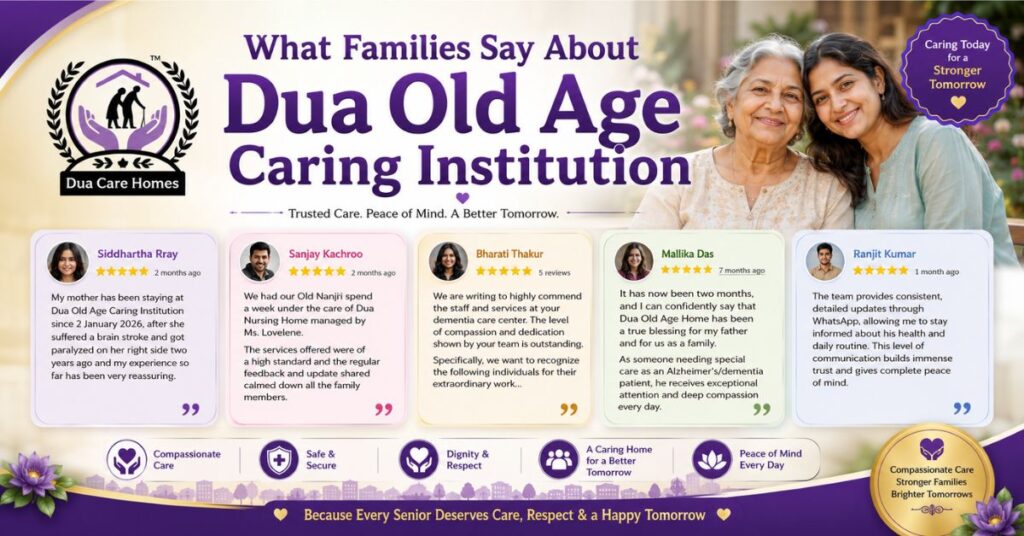
Real feedback matters more than any claim a facility makes about itself. Here’s what families have shared across Google Reviews and Justdial after placing a parent or grandparent at Dua:
- One family, whose mother was admitted following a stroke that left her partially paralysed, described the experience as reassuring — noting that after visiting several other institutions, the founders and staff stood out for being consistently attentive and respectful toward residents.
- Another reviewer, caring for a father with advanced dementia, shared that the staff’s attentiveness gave them genuine peace of mind, calling it a great fit for his specific needs.
- A family whose grandmother stayed short-term praised the regular updates and overall standard of care, while suggesting meal variety could be improved further.
- Reviewers on Justdial have repeatedly highlighted affordable, hygienic care and a management team that listens to residents’ day-to-day needs and preferences.
Current rating: 4.8 out of 5, based on verified reviews on Google and Justdial.
Frequently Asked Questions
What is the minimum age for admission to an old age home?
Most old age homes, including Dua, generally accept residents aged 60 and above, though this can vary based on health needs. It’s best to confirm directly with the facility for specific cases.
Is an old age home the same as an assisted living facility?
Not quite. Assisted living is a category of care within the broader old age home model, typically for seniors who need help with daily tasks but are largely independent. Old age homes like Dua offer both assisted living and more intensive medical/nursing care under one roof.
Are old age homes in Noida safe for elderly parents?
Reputable facilities are built specifically with senior safety in mind — anti-slip flooring, handrails, emergency call systems, CCTV monitoring, and trained staff. Always ask a facility directly about their emergency response protocol before admission.
Can NRI families stay involved in day-to-day care decisions?
Yes. At Dua, NRI families receive regular updates via calls, WhatsApp, and video visits, along with input on care plans, so distance doesn’t mean losing visibility into their parent’s wellbeing.
What if my parent’s health needs change after admission?
Because Dua offers both assisted living and specialised medical care (dementia, stroke, palliative, bedridden), care plans can typically be adjusted as a resident’s needs evolve, without requiring a move to a different facility.
How do I start the admission process at Dua Old Age Caring Institution?
You can call +91 98701 10433 or email info@duaoldagecaringinstitution.com to schedule an initial consultation and facility visit.
Making the Right Choice for Your Family
Choosing an old age home is rarely an easy decision, but it’s one that — made thoughtfully — can genuinely improve an elder’s quality of life. Look beyond marketing claims: ask about staff training, emergency protocols, real day-to-day routines, and talk to families who’ve already made the choice.
Dua Old Age Caring Institution in Sector 63A, Noida, welcomes families to visit, ask questions, and see the facility in person before making any decision. If you’re exploring options for a parent or loved one, reach out to schedule a consultation:
📞 +91 98701 10433 📧Contact Us📍 D-15, Sector 63A, Noida, Uttar Pradesh 201301